


Existing Customer Activation: Using Context Mining to Drive Measurable Revenue
Reactivating existing customers is one of the most effective strategies in sales. Yet many companies fail to systematically tap into this potential.
The reason is rarely a lack of creativity.
More often than not, what’s missing is a structured approach.
Existing customer activation is not a campaign project.
It is a system—one that consists of three key steps.
1. Analyze customer history – Context mining instead of gut feelings
Successful reactivation doesn't start with an email, but with analysis.
Context mining refers to the systematic analysis of existing customer data to identify specific, actionable opportunities for reaching out to customers.
Key questions include, for example:
- Which products or services were purchased, and when?
- When was the last time you were in contact?
- Were there any requests for quotes, service calls, or consultations?
- What are the typical purchase or renewal cycles?
Without structured context mining, reactivation remains haphazard.
Clearly analyzed data yields valid trigger points and clear opportunities for engagement.
Context replaces conjecture.
Systematic thinking replaces knee-jerk reactions.
2. Personalized outreach based on context
Relevance isn't determined by frequency, but by how well it fits.
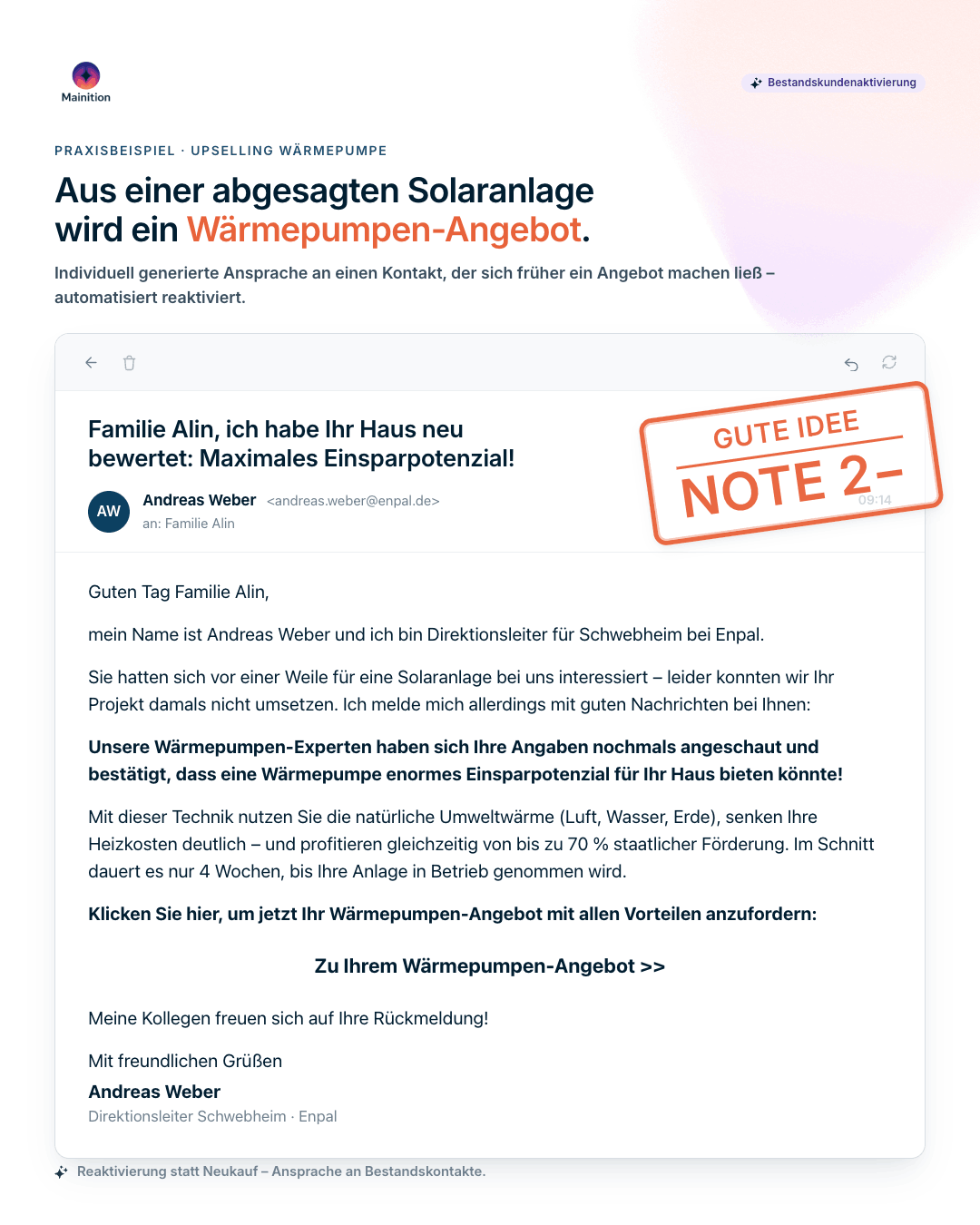
The insights gained from context mining form the basis for a personalized approach. The more precisely the message relates to past collaboration, the higher the likelihood of a meaningful response.
Proven starting points include:
- Reference to previous projects or product purchases
- Classification within known purchasing cycles
- Taking the customer's current situation into account
- Targeted outreach instead of a standard campaign
- A personalized message instead of a generic one
Successful customer engagement conveys to the recipient:
“This message is directly relevant to me.”
This is precisely where the difference between campaign logic and a systematic approach becomes apparent.
3. From Context to Conversion – Consistently Capitalizing on Sales Opportunities
Context alone does not generate revenue.
The identified opportunities must be actively converted by the sales team.
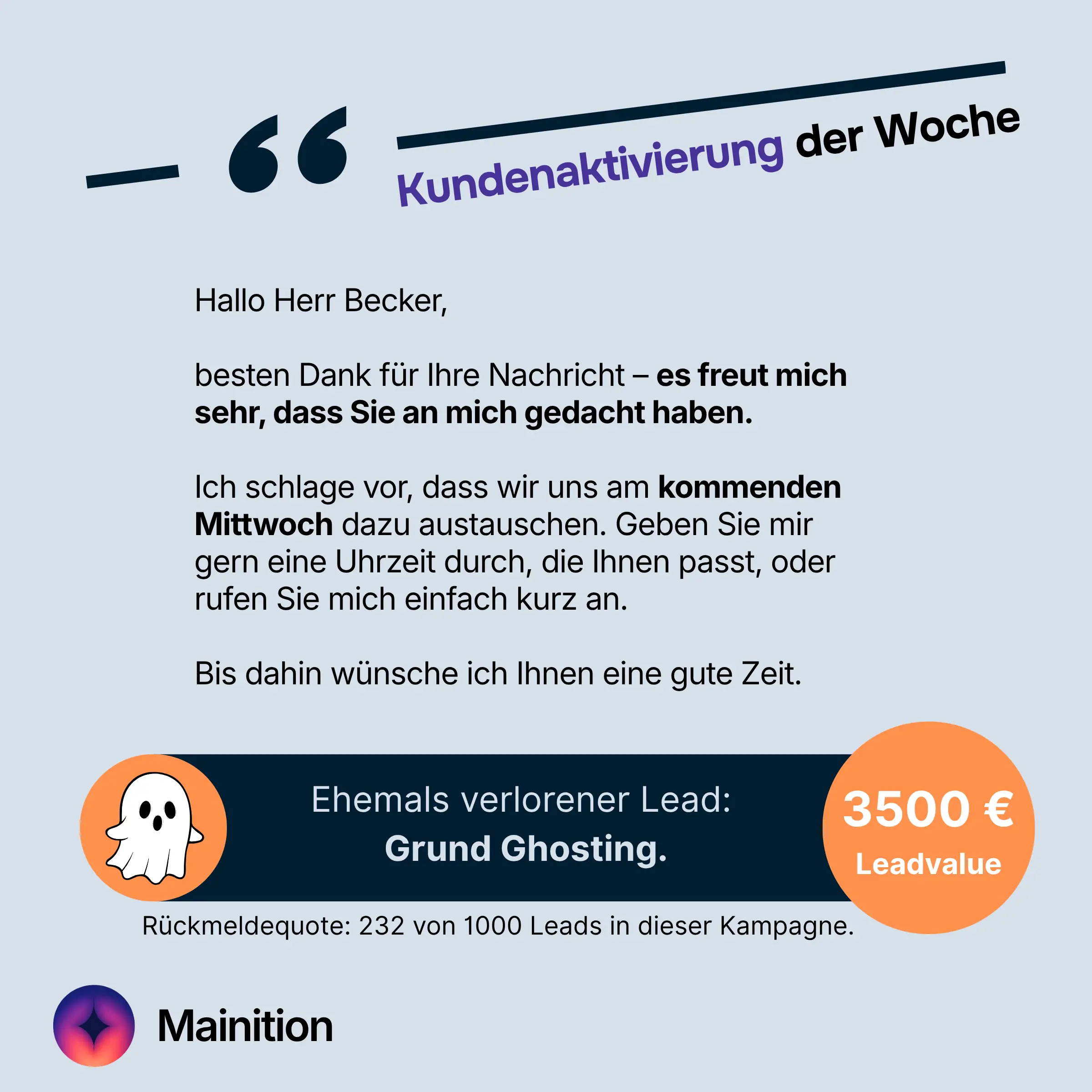
This means that every response requires a clear, defined follow-up action.
Real-world examples:
- A customer informs us that there is a new point of contact → Update contact information and actively seek to establish communication.
- A customer expresses general interest → Qualify the lead and follow up promptly.
- A customer requests an appointment → Schedule a firm appointment and prepare for it.
Reactivation should not be a haphazard follow-up, but rather a structured process with clear responsibilities and response times.
A professional approach therefore combines:
- Automated pre-qualification of relevant customers
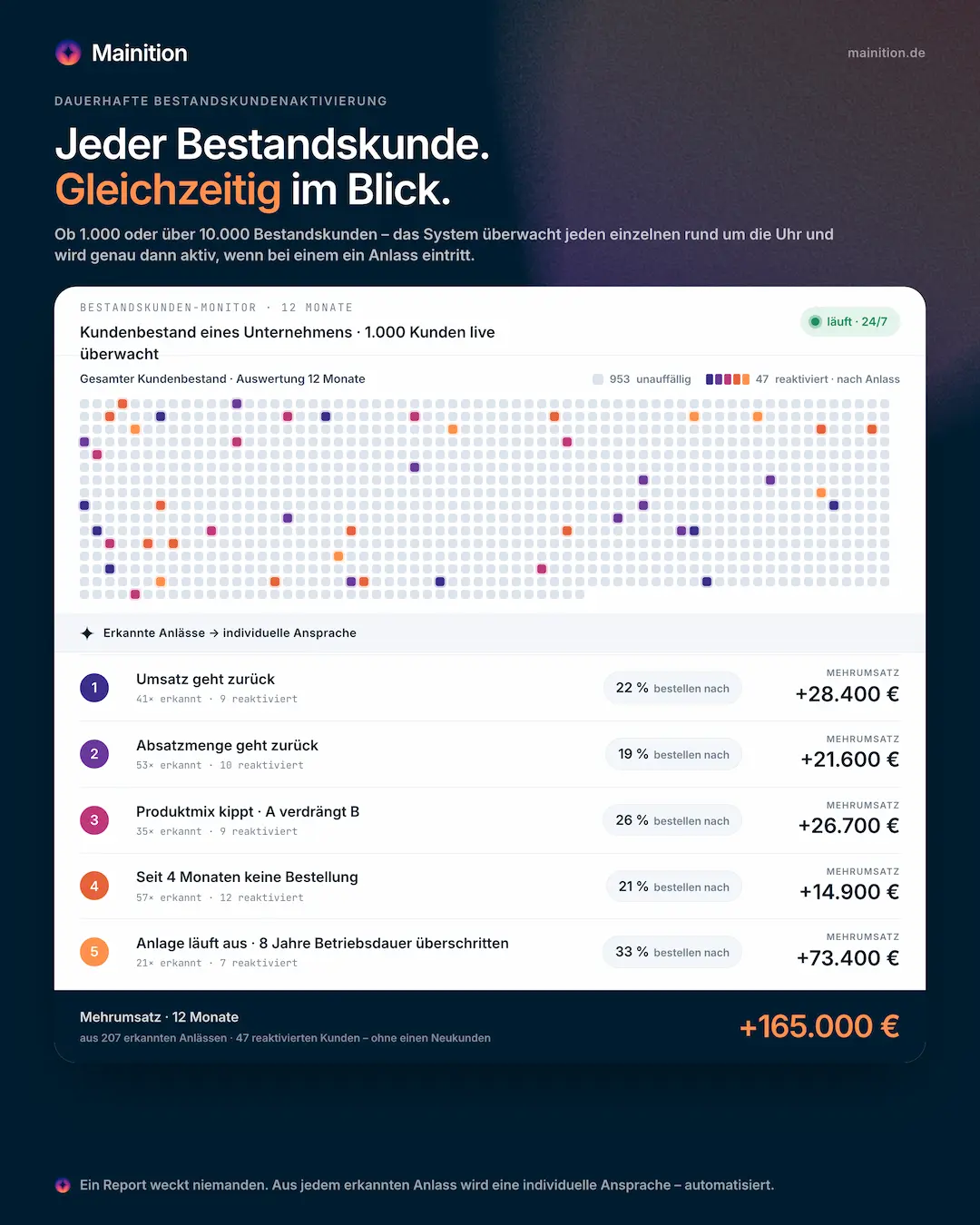
- Defined trigger points (e.g., inactivity, purchase cycles, contract terms)
- Clear next steps depending on customer feedback
- Structured handoffs and follow-ups in sales
This ensures that sales resources are deployed strategically—where there is a real likelihood of closing a deal.
The result:
→ Reduced operational effort
→ Greater relevance in customer interactions
→ Increased measurable revenue
Conclusion: Customer retention is a system
Existing customer activation is not just a campaign topic.
It is a structured process consisting of three key steps: context mining, personalized outreach, and consistent sales execution.
By consistently combining these steps, you can build a solid foundation for lasting customer relationships—without having to hire additional staff.
Systematic approaches create efficiency.
Context creates relevance.
Consistent implementation drives revenue.
Anyone can follow these steps. For larger customer volumes, a structured approach is required. Mainition provides this.

.png)